RapLab: never let the model count syllables
Ask a language model for a German rap verse with twelve syllables per line and an AABB rhyme scheme, and you get something that sounds right and counts wrong. Lines drift to fourteen syllables. “Rhymes” turn out to share a letter, not a sound. And when you ask the model to check its own work, it cheerfully confirms that everything fits.
The model is not bad at writing. It is bad at measuring. So RapLab splits the job.
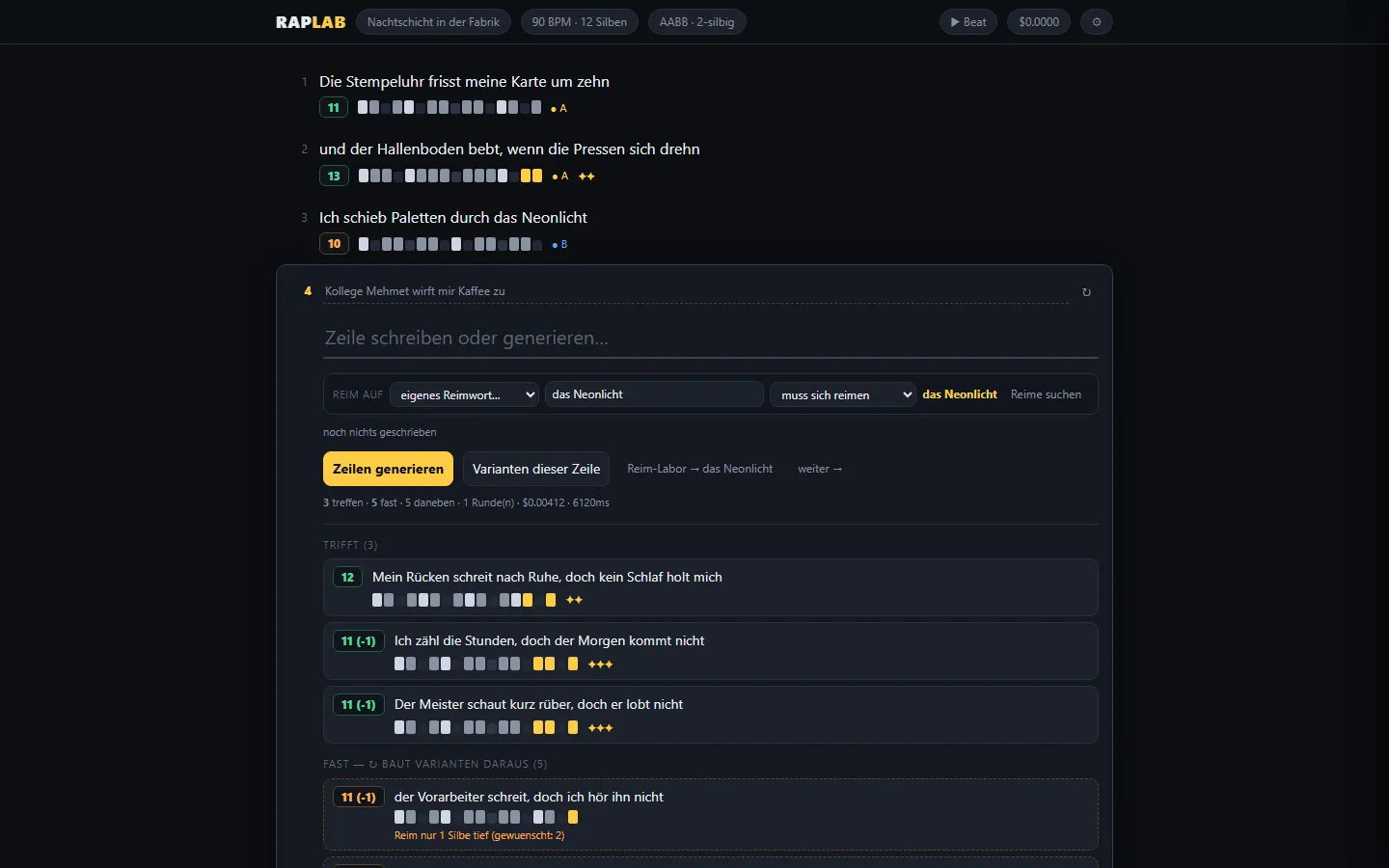
Over-produce, then judge
For every line, the model writes far too many candidates: 16 to 24 per round, up to three
rounds. None of them is trusted. A small deterministic module, syllables.py, measures
every candidate, and only then do I see them, sorted into hits, almost and off.
- The number badge is the measured syllable count, with the difference to the target.
- The blocks under each line are its syllables, and the highlighted ones are the rhyming tail.
- The stars are rhyme depth: how many syllables from the end still rhyme.
I pick. The model never gets the final word, and it never gets to grade itself. That split is why it works, not the prompt.
How the judge hears German
The judge is about two hundred lines of rules, no dictionary, no model:
- Syllables are vowel groups. Diphthongs (ei, au, eu, äu, ie) are taken first, so Stunden counts two and Neonlicht three. Words ending in -ie are one syllable (Melodie), except a hard-coded list of Latin loanwords that split (Fa-mi-li-e). There is no rule that tells those apart, so it has to be a list.
- A rhyme is a vowel sequence. The rhyme key is the vowels of the last n syllables, and the consonants between them don’t matter. That makes Tonnen schwer, kommen her and hoffe mehr one family, which is how rap actually rhymes. Vowels that sound alike are merged first: ä = e, ai/ay/ey = ei, ie = i.
- A pure rhyme is a bonus, not a requirement. The final consonants are compared after sound rules (silent h dropped, sch/ch/ck/ph/tz collapsed, final d/b/g read as t/p/k, so Rad rhymes with Rat). Assonance alone already counts as a hit.
- Depth is measured. The judge walks back one, two, three syllables until the vowels stop matching. doch der Morgen kommt nicht against das Neonlicht reaches three deep.
- Repetition is word overlap. A candidate that shares three content words with a finished bar is a repeat, whatever the word order. Ending on the anchor word itself is always rejected.
Four prompt traps
These each cost an evening. They generalise well beyond lyrics.
- Don’t hand the model a list of mandatory endings. Given a list of rhyme words, it glued fragments onto the end of lines to satisfy it: grammatical nonsense with a perfect rhyme. The list is now inspiration only, and the judge decides phonetically.
- Forbid the obvious, explicitly and repeatedly. With the anchor der Sonne, 37 of 48 candidates simply ended on Sonne again: an identical rhyme, worthless. With an explicit ban it dropped to zero, and one round produced ten hits instead of two in three rounds.
- Force a new rhyme family per block. Otherwise the model keeps continuing the sound of the previous lines, and a whole track ends on the same syllable.
- Tame output is often your own fault. Bars that were too polite came from my own system prompt, not from a policy. There is now an explicit intensity setting.
Cost
With a fast model a bar costs about a third of a cent to draft; with a stronger one about a cent, and noticeably better German. Sixteen bars come to ten or twenty cents. The judge is free and provider-agnostic: any OpenAI-compatible endpoint (a local model via Ollama, or a router) can be plugged in as a second generator.
The general pattern
Whenever a task has a part that can be measured, take that part away from the model: syllables, dates, sums, lengths, whether a citation exists. Let the model do what it is good at, which is producing many plausible options, and let a boring, deterministic piece of code throw most of them away.
The code is open source: github.com/F3S0J/raplab.